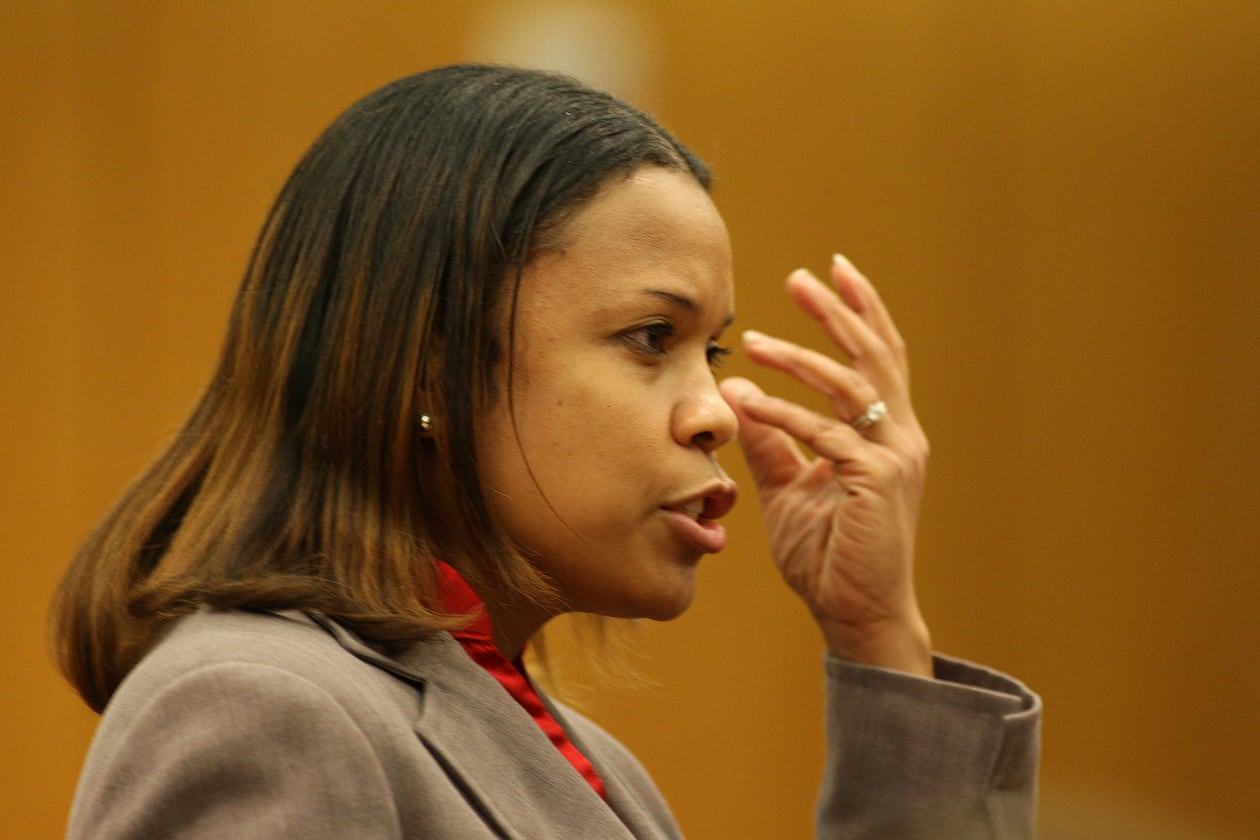
Fani Willis says she shouldn’t have to pay nearly $17 million in legal fees to President Donald Trump and his allies after her prosecution against them fell flat, in a filing that also attacked a new Georgia law allowing them to bill for the costs.
In a new filing, the Fulton County district attorney argues having to pay such a “preposterous sum” would wipe out her office’s annual budget. She also said the 2025 law crafted by Georgia’s conservative lawmakers — with her then-pending prosecution in mind — is vaguely worded and cannot be applied retroactively.
The legislation allows criminal defendants to recover attorney fees and litigation costs from prosecutors who have been disqualified, if the prosecution is dismissed. But Willis’ filing seeks to poke holes in the constitutionality of the new law that has drawn criticism since its introduction.
Willis called the request for legal fees a “stark example of the punitive, nonsensical schema” created by the bill, which she said leaves Fulton taxpayers on the hook for millions of dollars while stripping “a significant percentage (perhaps all)” of her office’s annual budget.
Trump alone is seeking just over $6.2 million in attorney fees and litigation costs tied to his defense in the election interference case that was dismissed last year.
Many of the claims asserting widespread fraud during Georgia’s 2020 presidential election were cited in the affidavit used by the Justice Department ahead of the FBI’s recent raid on the Fulton County elections hub.
Willis was disqualified from the case over her romantic relationship with then-special prosecutor Nathan Wade, whom she hired.
The DA called the Trump defendants’ request for nearly $17 million a “suitably preposterous sum for a surreal and unprecedented legal proceeding” that she believes could have continued.
She noted four people pleaded guilty, and argued the prosecutor who inherited the case after her disqualification could have pursued charges against each of the remaining defendants had he wanted to.
Instead, Pete Skandalakis, the executive director of the Prosecuting Attorneys Council of Georgia, elected to drop the remaining charges, finding that the case could have been brought in federal court instead of Fulton County.
That determination, that the claims were more appropriate for another venue, didn’t undermine the strength of the evidence in the case, Willis said in her latest filing.
“The District Attorney has no intention of allowing Fulton County taxpayers to pay such an absurd amount for such an absurd reason,” she said.
Willis argued the defendants’ claims include “preposterously expensive” hotel stays and “seafood lunches costing hundreds of dollars.”
Many of those expenses, she said, were bills that were picked up by the Georgia Republican Party and Trump’s political action committees. Those charged in the election interference case, she said, “are not entitled to the enormous windfall they expect to collect.”
Mark Meadows, who maintained throughout the entire case that he shouldn’t have been named in part because he wasn’t directly connected to anything that happened in Georgia, asked for more than $2.2 million in expenses, but submitted invoices that were completely redacted.
The former chief of staff’s lawyers “have essentially said ‘just trust us’ and asked this court to ignore its duty to assess reasonable fees,” Willis argued.
Jennifer Little, an attorney for Trump, billed for $1,000-a-night luxury hotels in Florida, after Willis herself was criticized for staying at a Doubletree, the DA said in the filing. Plus, Little included expenses that Willis’ office argued were too vague to stand: $650 for “expense,” and $15,000 for investigative costs, without details about what those expenses and investigations entailed, according to the filing.
“All that is present are vague entries that give no insight into whether this work was reasonable or necessary to begin with, much less whether the work could reasonably require 206.7 hours, at an average of more than 10 billable hours per day for 20 straight days,” the DA said.
Some of the defendants are billing at attorneys’ rates for what amounts to secretarial work, the district attorney said. For example, one defendant billed $820 to prepare a cover letter and drop it off at the Fulton County courthouse. Another asked for $2,000 for delivering a blank hard drive to co-counsel in Atlanta, according to the filing.
And some of the expenses filed were duplicative, she said. For example, John Eastman, a now-disbarred lawyer who led efforts to overturn the 2020 election results in Georgia and elsewhere, sought compensation for a $100,000 retainer for his defense attorney in the prosecution. But he also sought expenses that were charged against that retainer, essentially double-dipping for the same costs, the district attorney’s office said in the filing.
Willis also took aim at the wording of the new law, arguing the defendants have no right to attorneys’ fees because she was disqualified over an appearance of impropriety rather than actual improper conduct.
While the bill’s language refers to a prosecutor’s “improper conduct” that results in their disqualification from a criminal prosecution, Willis notes that the law doesn’t explain what that actually means.
“The statute fails to provide fair notice to prosecutors as to what conduct it intends to penalize,” Willis said, calling the wording “too subjective.”
The filing also says the bill fails to clearly define what is meant by “prosecuting attorney.”
Willis questions whether the statute applies only to disqualified DAs or solicitors-general, or if it also extends to disqualified assistant DAs and solicitors, even if their office is still handling the case.
She also argued the new law is unconstitutional because it can’t be uniformly applied to all prosecuting attorneys in the state.
The bill itself says fees and costs shall be paid from the funds of the office “budgeted by the county or counties comprising the judicial circuit of such prosecuting attorney.” But Willis said Georgia’s attorney general, the Prosecuting Attorneys’ Council and municipal prosecutors are not funded by counties.
In a court filing, even Skandalakis raised concerns about the constitutionality of the new law.
And as for the bill’s intent, the defendants are asking Fulton taxpayers to fork over nearly $17 million under the presumption that the bill applies to conduct “that occurred years before the statute was passed or even contemplated.”
“This retroactive application of the law to punish past conduct is a clear violation of the Georgia Constitution’s explicit prohibition on retroactive legislation,” Willis said.
About the Authors



Keep Reading

The Latest

Featured