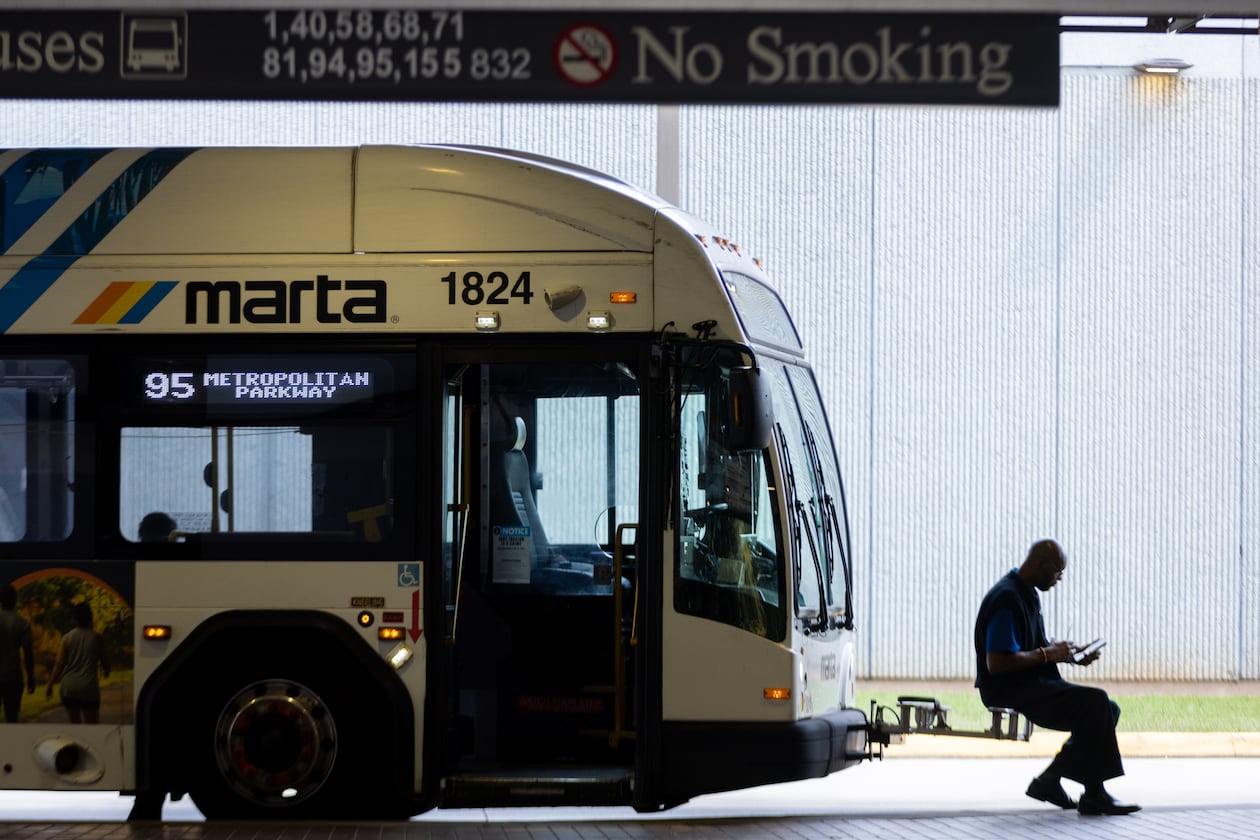
MARTA has agreed to pay $52 million to resolve a longstanding dispute with the City of Atlanta, whose auditors say the transit agency overcharged for enhanced bus service.
The settlement, approved by MARTA’s Board of Directors in a special-called meeting Thursday, is for less than the city has argued MARTA owed — $70 million. But it’s significantly more than the $865,000 that MARTA officials and its auditor have argued was due, and represents a significant concession by the agency in the interest of putting the issue to rest.
The spending dispute has been a thorny issue for years. It led to a whistleblower lawsuit that alleged mismanagement and was ultimately settled; an accusation by MARTA that Mayor Andre Dickens held up construction permits in an attempt to pressure the agency to agree to the city’s terms; and a declaration by the chair of MARTA’s board that she had lost confidence in then-general manager and CEO Collie Greenwood.
The impasse also stalled conversations between the city and the agency about how to move forward with projects in the More MARTA program from which the money originated — and which, 10 years in, has not delivered on a single completed capital project.
At the core of the issue: The degree to which the transit agency overcharged the More MARTA operating expense fund — revenue from a half-penny sales tax voters approved in 2016 to pay for transit expansion projects.
Thursday’s settlement includes $19 million MARTA has already paid back, an amount that includes overcharges identified by the city auditors that MARTA didn’t dispute, as well as roughly $10 million the agency paid as a good-faith gesture.
The remaining settlement funds will be paid back to the More MARTA capital fund monthly over the next two years. The full $52 million will then be freed to go toward an array of capital projects the city has said it wants to pursue, including light rail on the Atlanta Beltline and new train stations.
Atlanta and MARTA officials said the agreement offers a fresh start.

Credit: Getty Images
Credit: Getty Images
“This agreement puts a long-running dispute behind us and allows us to put our full focus where it belongs — delivering the transit investments Atlantans voted for,” Dickens said in a statement. “We can disagree, work through difficult issues and still find a way forward.”
The board began discussing the final settlement terms two weeks ago, MARTA board Chairperson Jennifer Ide said. That’s the same day Jonathan Hunt was named to the general manager and CEO position permanently, a role he filled on an interim basis for the last year.
Hunt said the resolution gives MARTA and the city “an opportunity to turn the page.”
Other current and former officials from both the city and MARTA who questioned the More MARTA accounting over the years said they felt vindicated by the settlement. Former City Council President Doug Shipman, who was one of the loudest voices pushing for the city’s audit, said he was relieved.

Credit: Hilena Haileselassie
Credit: Hilena Haileselassie
“I’m gratified to see that Atlanta residents are receiving fair restitution for mistakes made with taxpayer dollars by MARTA in the past,” he said.
Former MARTA Deputy General Manager Josh Rowan said he was also glad to see a resolution. Rowan, a former ATL DOT commissioner, filed the whistleblower lawsuit in 2024 after he was fired by MARTA. Rowan’s lawsuit, which settled for $60,000, alleged inaccuracies in the More MARTA financial reports being given to the city.
“It’s great to see MARTA and the city working together to put this matter behind them and refocus on More MARTA,” Rowan said in a statement.
A former ATL DOT deputy commissioner, Doug Nagy, who brought his concerns about the spending to city and MARTA officials more than four years ago, also applauded the agreement. Nagy said he’s grateful MARTA’s new leadership had “made this right” — and now must ensure it never happens again.
Rod Mullice, a former MARTA board member, said he hopes the settlement will restore trust in the transit agency. Mullice resigned in 2023 amid an ethics probe that concluded he created a hostile work environment, allegations he disputed and has previously said were in response to the questions he was asking about the More MARTA operational expenses.
“This is a great day,” Mullice said Thursday.

Credit: Miguel Martinez/AJC
Credit: Miguel Martinez/AJC
The More MARTA money fight has been ongoing for almost as long as Atlantans have been paying the extra half penny.
MARTA initially split the proceeds evenly between operating and capital funds. While the final capital project list was being debated, MARTA began increasing bus service on Atlanta routes.
Fairly quickly, some in the city began to express concern that too much was being spent on operations. The enhanced bus service was ultimately scaled back in Atlanta, and across the entire MARTA service area, when the COVID-19 pandemic hit in 2020.
Auditors hired by the city and MARTA both tried to determine how MARTA calculated charges to the More MARTA fund for the extra bus service while it lasted. The city’s auditors, Mauldin & Jenkins, said MARTA could not provide documentation. MARTA’s auditors, KPMG, determined MARTA had a methodology that charged for any improvements beyond the base service levels in 2017.
That methodology worked fine before the pandemic, one of MARTA’s auditors said, but didn’t work after. It incorrectly attributed decreases in service anywhere to the Atlanta operational fund.
KPMG recommended MARTA calculate Atlanta service enhancements as a proportion of its overall service. Under that method, they tallied overcharges totaling $865,630.
The city’s auditors took a different approach, and they arrived at $70 million.
MARTA strenuously disputed the Mauldin & Jenkins total when it was announced in 2024, with Greenwood describing their methodology as arbitrary.
Once KPMG’s findings were released, Greenwood said he couldn’t support a “meet in the middle” approach to resolve the issue because it would unfairly take money from taxpayers in DeKalb, Fulton and Clayton counties who pay into MARTA’s general operating fund that would absorb the cost of any settlement.
This prompted Ide, who represents Atlanta, to say she no longer had confidence in Greenwood’s leadership, comments she quickly walked back. She said if MARTA refused to compromise with the city, it would “do irreparable harm to the relationship.”
Greenwood told her “there is a larger landscape at play here. We serve more than the city of Atlanta.”
Thursday’s settlement goes farther than what Greenwood warned against.
The budget impacts to MARTA’s operating and capital expenses aren’t yet clear.
MARTA Deputy Chief Financial Officer Greg Patterson said, most likely, operational expenses will not be affected. Instead, there will just be less money for MARTA’s state-of-good-repair fund, which pays for upkeep across the entire system.
Potentially, it could mean projects are deferred or scaled back. MARTA could also issue bonds and take on more debt to keep the current project schedule.
“We haven’t got to the point where we’re going to make that decision,” he said. “But similarly, we’re always looking for ways to save on costs and so the net effect might not even impact a project.”
There are still significant More MARTA decisions to resolved that could lead to more feuding.
Atlanta City Council members have asked to renegotiate the intergovernmental agreement overseeing the program because they want a greater say.
And before the additional More MARTA money can be spent, officials need to decide what they want to prioritize. There’s no agreement on a project list at the moment, something MARTA officials have asked the city to provide for more than a year.
Mullice advised everyone involved to move forward quickly.
“The most important thing is to take that (list) that the voters approved in 2016 and get as close as humanly possible in these current economic conditions to what voters wanted,” he said.
About the Author



Keep Reading

The Latest

Featured